01Three possible directions
Aiofb could support automation case notes, a small software studio documenting decisions, or a research group comparing how information moves through everyday tasks. These are development possibilities, not descriptions of an operating service. Their shared requirement is clarity: readers should understand what a tool receives, what it produces and who checks the result. A narrow first collection, such as meeting notes becoming assigned actions, would give the identity a concrete starting point. A broader library could follow once the editorial format makes individual cases easy to compare.
02Show the boundary
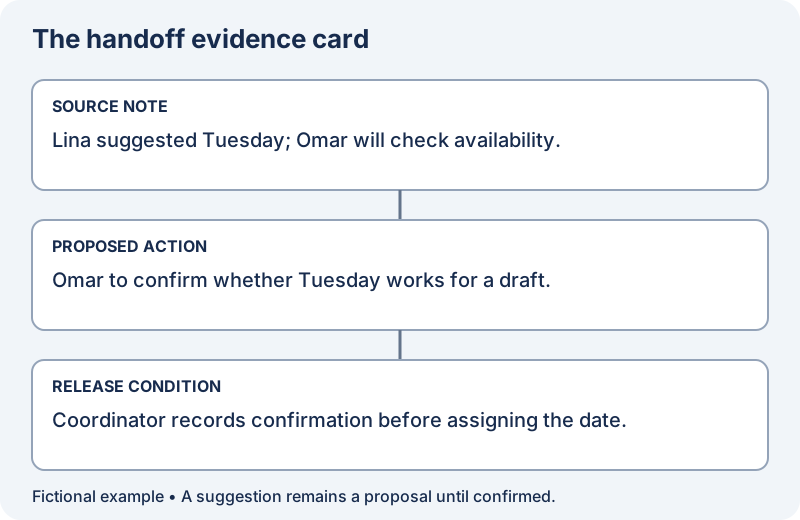
A handoff is often where a useful draft becomes an unreliable commitment. A note may say that someone proposed a date, while the next system treats the date as approved. A workflow notebook should therefore separate original input, interpretation and confirmed action. Showing those states gives a reader something practical to inspect and prevents polished output from concealing uncertainty. One paragraph of fictional notes, a proposed action list and a marked approval decision are enough to demonstrate the boundary without claiming that a complete system has been evaluated.
03Make revisions legible
Each entry could include the attempted task, allowed input, expected output and point where a person remains responsible. Describe failures as specific mismatches rather than broad judgments about a tool. If an example changes, preserve the earlier version and explain the correction. Readers can then distinguish a revised instruction from changed input. A revision label should travel with any screenshot or downloadable worksheet so detached copies remain identifiable. This gives a small collection practical value before there is an interactive product or a large archive.